
I just finished reading this book and I highly recommend it, especially if you think you know all you need to know about Martin Luther King, Jr’s legacy. You will find out there’s so much more to the story.
It took me awhile to read because I’d read a section and then take some time to reflect on what I learned.
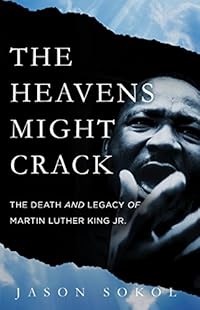
Sokol explains how people in different places and settings learned the news when King was shot on April 4, 1968. He explains what else was going on in our national culture at the time, how the nation was incredibly divided in its view of King, and how over time the memory of King and his work has changed drastically.
As an example of that change, note that the last chapter is titled “From Outlaw to Saint.” During his lifetime, there were plenty of folks who reviled King, but over time the memory of what he advocated for has been changed.
The book is well sourced, as I would expect from a history professor who specializes in the civil rights movement. He describes how all facets of society in both the U.S. and across the world reacted to King’s death. For example, since I spend a lot of time in North Carolina, I was especially interested to read about how people reacted in an d around the campus at Duke University (Durham, NC).
On the night of April 4, word of King’s assassination rippled across the Duke campus. Jack Boger, a senior, was attending a Religion Department symposium when a student walked down the aisle and announced that King had been shot. “The theology of hope seemed instantaneously irrelevant,” Boger remembered. He left immediately, stunned and upset. … the mood on campus [was] “a mixture of sadness, fear, guilt, and frustration, undergirded by a conviction that our world had turned a corner … and could never be the same again.” But President Douglas Knight remembered that on the Duke campus and throughout the city of Durham, “there were a good many white people rejoicing.” (p. 120-121)
Even though I know racial prejudice, hatred, and ugly actions were all a part of our society back then, I realize these conditions are still very much a part of our society today. Reading this book, I still recoiled every time I read another situation in which people reacted with joy to learn King was dead — and the hateful things they said. So many people only saw King as a trouble maker. They thought he was just stirring up chaos when they just wanted everything to remain the same in society. But maintaining status quo usually means someone is being treated unfairly, unjustly, and back in the 60’s this was very much the case. Sadly, I fear there is still much injustice.
It’s a good read. I encourage y’all to read it! Our history is important to know.




 Think ICT
Leave a comment