I attended a conference this weekend at the wonderful Green Acre Centre of Learning in Eliot, Maine. Making time to attend this particular conference was my birthday present to myself (yes, I’m getting better at self-care).

This was the first conference sponsored by the newly established Corinne True Center for Baha’i History. Between Friday evening through Sunday at noon, a total of 14 scholars gave presentations on a wide range of topics in a variety of formats. Although there were technical difficulties when attempting to live stream each session (gotta love technology), I look forward to either watching the recordings and/or reading the various papers presented.
Since I have a place to stay nearby, I was a commuter to Green Acre, but most folks stayed on campus. We all enjoyed several wonderful meals in the dining hall at the Sarah Farmer Inn.
If you have never been to this historic place in an idyllic setting along the Piscataqua River just north of Portsmouth, NH, it has a remarkable past that began in the late 1800’s. Green Acre has been continuously focused on promoting peace across the planet. Kudos to the staff and volunteers who hosted another wonderful weekend of deep thought, prayer, visits with old and new friends, and tasty meals.
Here are a few of my notes as I reflect on the sessions. Overall, it was a stellar event for me, as a lover of history and especially of biography. Although I have a doctoral degree myself, I’ve worked much more in the practical realm, so my level of researching and publishing is not even close to the level of the academics who presented. Nonetheless, I am inspired to “up my game” over the next year. Out of the 14 presenters, a few were seasoned professors, a few were mid-career, and several were young and creative. All of them provided so much food for thought.
- Todd Lawson‘s talk on Friday evening was about the Surih of Joseph and so much more. When he began his talk, he pointed out that metaphors are essential to our learning about God and the unseen world. Being able to connect to things in the physical world helps us to grasp concepts that aren’t physical. I was somewhat mesmerized as I watched Dr. Lawson’s responses in various discussions throughout the weekend because it was almost like you could see his mind reverently connecting to invisible thought bubbles.
- Matthew Hughey described his study of articles on race that were published in the very first Baha’i magazines of the U.S. during the early 1900’s, such as World Unity and Baha’i World. I really enjoyed hearing how deeply he analyzed the articles in these publications — some of which were quite jarring. He is working on a book which will contain much more beyond what we heard during this short presentation.
- Richard Hollinger highlighted several lesser known Baha’i figures involved in race unity efforts prior to the civil rights era. He shared so many names that I’d never heard of, so I hope he’ll publish more about them because I want to know more about their lives!
- Janice Ndegwa‘s talk on the growth of the Baha’i Faith in Africa during the early 1950’s was quite fascinating. I really enjoyed her slides and narrative, full of maps and other graphics that provided context to the activities and people involved.
- Julie Gentzkow provided a huge number of photos of Dr. Elsie Austin and her family. We learned that her mother was very instrumental in the establishment of the Tuskegee Institute. There were so many more details about her family that, again, I hope she will publish her slides or a full paper.
- Joshua Hall is immersed in some fascinating studies of philosophy, some of which he shared in his talk. He talked about the rational soul, materialism, and more ideas related to the powers of the mind. As he’s currently immersed in doctoral work at UCLA, I look forward to reading many more interesting insights in the years to come from Joshua.
- Todd Smith discussed historical consciousness, the need to recognize the oneness of humanity, especially as we are living in an age where both disintegration and integration are occurring to move humanity forward. While I was wishing Dr. Smith had slides to accompany his talk, since I find visuals to be extremely helpful in grasping abstract concepts, I look forward to being able to spend some time reading and reflecting on the paper he presented because his ideas deserve more reflection.
- Brent Poirier‘s topic was on the institution of the Guardianship in the Baha’i Faith. He had a handout for us with numbered lines for ease in locating the text he was discussing. This handout was incredibly helpful as we took a look at specific sentences within several passages about the topic.
- Iqan Shahidi shared a lovely comparative study in which he analyzed four Baha’i scholars’ (Davoudi, Hatcher, Arbab, and Smith) ideas about science and religion. His slides contained helpful notes about each scholar’s ideas. I was grateful to have the shapes, colors, and text of those slides as he talked.
- Sandra Hutchinson provided an evening presentation of the poems of Mahvash Sabet. Although I had to leave before Dr. Hutchinson’s presentation began, I must say this was no ordinary talk, as Sabet is no ordinary person. She was imprisoned for a decade in Evin Prison in Iran, solely because of her belief in the Baha’i Faith — and although she was released, she has now been unjustly imprisoned yet again by Iranian authorities. This level of fortitude is well beyond what most of us are ever expected to endure as we face the difficulties of living in this world. Sabet’s poems are available through George Ronald Books.
- Adib Masumian has been translating into English many previously unpublished Baha’i writings. Using newly translated material, Adib shared facts and insights about ‘Abdu’l-Baha’s second journey in Europe during 1912-13. This talk reminded me I started but haven’t finished reading his book about this!
- Chris White‘s talk was an “oh my goodness” moment for me. I loved that he focused on environmental concerns and how we as humans need to understand the fundamental oneness of all things, including our need to recognize that materialism is fast overtaking our environment. In particular, I appreciated the first reference he made to Lynn White’s publication in 1967 on “The Historical Roots of our Ecological Crisis.” Note that in 1967 we were already recognizing the damage being made to the earth. I feel like memorizing this quote: “More science and more technology are not going to get us out of the present ecologic crisis until we find a new religion or rethink our old one.” Note the reference to technology as we are immersed in our 21st century world full of social media, AI, and all the rest.
- James Russell‘s talk on medievalism was just a fascinating journey into references to medievalism within the Baha’i Writings. His slides included lots of images which enlivened and illustrated his points. The audience, in an audible response, clearly appreciated his comment about how the ISGP program for college students was basically a lifeline while he was immersed in his doctoral dissertation studies.
- Ney Grant was last but certainly not least in the expertise he shared about the philosophical writings of Hegel and the Baha’i Faith’s focus on expanding oneness. His slides were fantastic and clearly showed that he understood the power of imagery to help viewers and readers better understand concepts being put forth. Again, I look forward to reading more of his papers.
A word of thanks must be given to Dr. Rob Stockman and the Board of the Corinne True Center for Baha’i History for their hard work in putting this gathering together. This was a historic first conference, with many excellent scholars presenting thought provoking ideas. I can’t wait till next year!
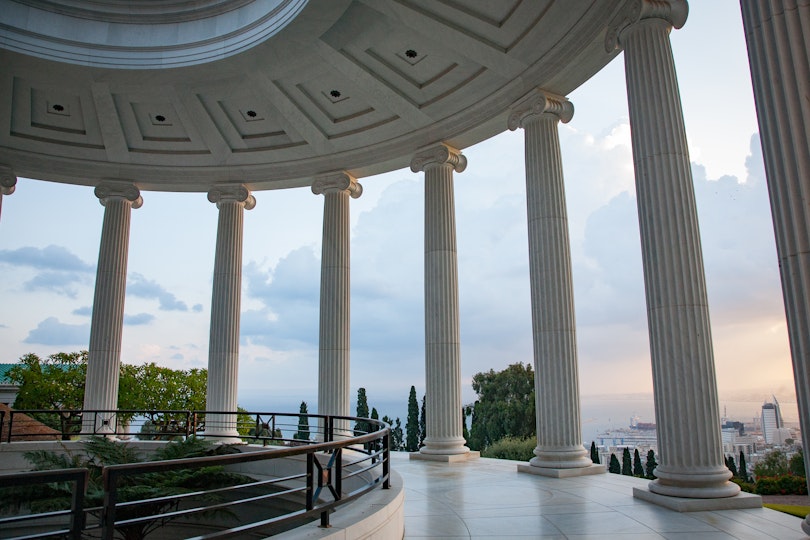
Featured image credit: View from the portico entrance of the Centre for the Study of the Sacred Texts in Haifa, Israel. Copyright © Bahá’í International Community




 Think ICT
Leave a comment